|
Clinical Image
Complete remission of metastatic mismatch repairdeficient/microsatellite instability-high esophageal adenocarcinoma following immunotherapy: A case report
1 FRCR, FHKAM (Radiology), Consultant Clinical Oncologist, Department of Clinical Oncology, Colchester Hospital, Colchester, Essex, UK
2 MRCP, FRCR, Consultant Clinical Oncologist, Department of Clinical Oncology, Colchester Hospital, Colchester, Essex, UK
3 FRCR, Consultant Radiologist, Department of Radiology, Colchester Hospital, Colchester, Essex, UK
Address correspondence to:
Eric Ka Chai Lee
Department of Clinical Oncology, Colchester Hospital, Turner Road, Colchester, CO4 5JL,
UK
Message to Corresponding Author
Article ID: 100158Z10EL2026
Access full text article on other devices

Access PDF of article on other devices


How to cite this article
Lee EKC, Loo SW, Juneja A. Complete remission of metastatic mismatch repair-deficient/microsatellite instability-high esophageal adenocarcinoma following immunotherapy: A case report. J Case Rep Images Oncology 2026;12(2):4–7.ABSTRACT
No Abstract
Keywords: Adenocarcinoma, dMMR/MSI-H, Esophagus, Immunotherapy, Metastasis
Case Report
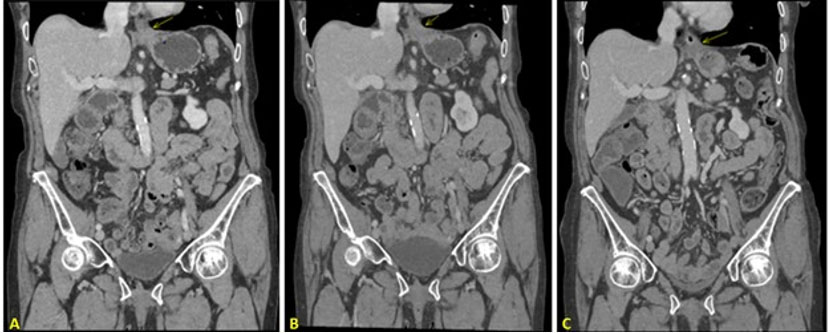
An 80 year-old Caucasian woman was diagnosed in 2022 with adenocarcinoma of the lower esophagus (35 to 38 cm from the incisors) with multiple metastases in the right hepatic lobe (Figure 1A, Figure 1B, Figure 1C). Esophageal biopsy confirmed poorly differentiated adenocarcinoma. Immunohistochemical analysis demonstrated a human epidermal growth factor receptor 2 (HER-2) score of 1+ and programmed death-ligand 1 (PD-L1) combined positive score (CPS) of 5 using the 22C3 assay. There was loss of nuclear staining for MLH1 and PMS2 in tumor cells, consistent with mismatch repair-deficient/microsatellite instability-high (dMMR/MSI-H) adenocarcinoma.
As the PD-L1 CPS was below the threshold recommended by the National Institute for Health and Care Excellence (NICE) guidelines for first-line immunotherapy in upper gastrointestinal (UGI) cancers, the patient commenced first-line palliative chemotherapy with oral capecitabine and intravenous oxaliplatin (CAPOX). She received three cycles between January and March 2023. Follow-up computed tomography (CT) on 29 March 2023 demonstrated disease progression, with an increase in the size and number of right hepatic lesions, the largest measuring 2.4 cm (Figure 2A, Figure 2B, Figure 2C, Figure 2D).
Given progressive disease and confirmed dMMR/MSI-H status, she was commenced on second-line immunotherapy with intravenous nivolumab 480 mg every four weeks. We chose nivolumab because this was the only immunotherapy option approved by NICE as second-line treatment for esophageal cancer. She received three cycles between April and May 2023. Treatment was temporarily discontinued due to an exacerbation of pre-existing psoriasis.
Computed tomography imaging on 29 June 2023 demonstrated a marked radiological response, with significant reduction in liver metastases and the largest lesion measuring 1.4 cm. Following improvement in psoriasis after ultraviolet phototherapy, nivolumab was resumed for a further three cycles between August and October 2023. Treatment was subsequently discontinued permanently due to recurrent psoriasis flares.
Serial follow-up CT scans in January, April, and October 2024 demonstrated stable mild distal esophageal wall thickening with complete radiological resolution of the previously identified liver metastases (Figure 3A, Figure 3B, Figure 3C). The patient remained clinically well with preserved oral intake. Esophagogastroduodenoscopy performed on 25 May 2025 showed an ill-defined area in the distal esophagus; biopsy revealed no evidence of residual or recurrent malignancy.
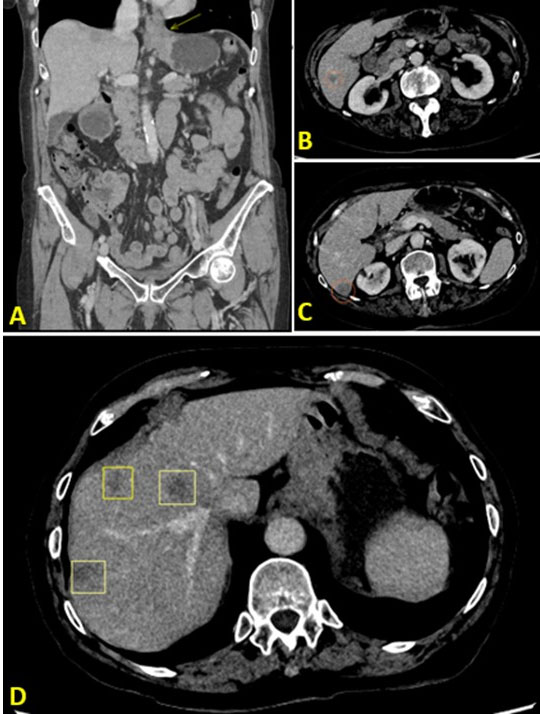
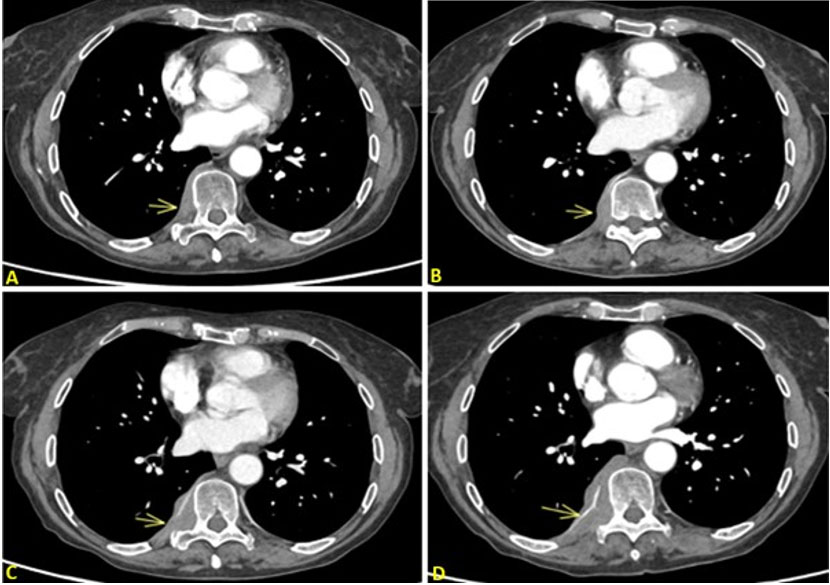
Computed tomography imaging on 24 April 2025 confirmed continued absence of liver metastases. However, there was progressive enlargement of a right thoracic paravertebral soft tissue lesion since January 2024 (Figure 4A, Figure 4B, Figure 4C, Figure 4D). The lesion was fluorodeoxyglucose (FDG)-avid on positron emission tomography (PET) performed on 17 May 2025.
The patient had a past medical history of stage IV follicular lymphoma diagnosed in 2019, for which she had received two cycles of rituximab-bendamustine followed by four cycles of rituximab, cyclophosphamide, vincristine, and prednisolone. Multidisciplinary review involving the upper gastrointestinal (UGI) and hematology oncology teams concluded that the paravertebral lesion was extrapleural and most consistent with indolent relapse of follicular lymphoma rather than metastatic esophageal cancer. As the patient was asymptomatic, close imaging surveillance was recommended.
A follow-up FDG-PET scan on 10 November 2025 demonstrated progression of the FDG-avid paraspinal mass and adjacent lymphadenopathy, with no evidence of recurrent esophageal or hepatic disease. Computed tomography-guided biopsy of a lymph node on 7 January 2026 confirmed relapsed follicular lymphoma.
At the most recent follow-up, the patient was receiving systemic treatment for follicular lymphoma. She had survived more than three years since the diagnosis of metastatic esophageal adenocarcinoma and had remained free from metastatic esophageal cancer for 30 months following immunotherapy.

Discussion
Microsatellite instability-high tumors are frequently associated with epigenetic silencing of mismatch repair genes, most commonly MLH1, leading to loss of protein expression on immunohistochemistry. dMMR/MSI-H status is a strong predictive biomarker for response to immune check point inhibitors (ICIs) and is associated with improved outcomes in several malignancies.
While ICIs are approved as first-line therapy for metastatic dMMR/MSI-H colorectal cancer, the prevalence of MSI-H in metastatic UGI adenocarcinoma is low [1]. C de la Fouchardière et al. carried out a pooled analysis of survival rates in the first-line and all lines for metastatic dMMR/MSI-H UGI adenocarcinoma, questioning the potential futility of chemotherapy. Although immunotherapy is recommended for metastatic dMMR/MSI-H UGI adenocarcinoma irrespective of PD-L1 expression, access may be influenced by PD-L1 CPS thresholds in certain healthcare systems.
In an exploratory analysis of the Medical Research Council Adjuvant Gastric Infusional Chemotherapy (MAGIC) Trial, Smyth et al. [2] showed that patients with operable gastroesophageal cancer with high microsatellite instability (MSI-H) did not benefit from perioperative chemotherapy. Patients with microsatellite instability-high tumors compared with microsatellite instability low tumors were more frequently female and had an older age. The MSI-H tumors were more frequently of Lauren intestinal histological subtype. Our patient, an 80-year-old woman had demonstrated disease progression following standard first-line chemotherapy CAPOX, consistent with previous evidence that MSI-H tumors derive limited benefit from the combination of platinum and 5-fluorouracil [3].
Clinical trial data supporting immunotherapy after first-line platinum-based chemotherapy in advanced gastric and gastro-esophageal junction cancers include the KEYNOTE-059 and KEYNOTE-061 studies. KEYNOTE-059 was a single-arm phase II trial investigating checkpoint inhibitor pembrolizumab in the third or later line for the treatment of advanced gastric and GEJ cancers. Six of 259 (2.3%) patients had complete response after pembrolizumab [4]. KEYNOTE-061 was a randomized phase III trial comparing pembrolizumab versus paclitaxel in the second-line setting for advanced gastric/GEJ cancers. In a post-hoc analysis of patients whose tumors had high levels of microsatellite instability, responses were observed in seven (47%) of 15 patients in the pembrolizumab group and in two (17%) of 12 patients in the paclitaxel group [5].
We recognized that the patient had a history of psoriasis which could be exacerbated by immune checkpoint inhibitor therapy. Because she had disease progression and also oxaliplatin induced neurotoxicity after CAPOX, she agreed to second line treatment with immunotherapy instead of paclitaxel. Eventually, she achieved a complete and durable response following nivolumab monotherapy, despite early treatment discontinuation due to immune-related toxicity.
This case illustrates the importance of recognizing MSI-H esophageal adenocarcinoma as a distinct biological subtype. Microsatellite instability-high status predicts differential response to systemic therapy and may confer a favorable prognosis, even in patients presenting with advanced-stage disease.
Conclusion
Although dMMR/MSI-H is uncommon in upper gastrointestinal adenocarcinoma, immunohistochemical testing for mismatch repair deficiency is recommended, especially for older female patients. This case supports the use of immune checkpoint inhibitor monotherapy in metastatic dMMR/MSI-H esophageal adenocarcinoma, with the potential for durable complete remission.
REFERENCES
1.
de la Fouchardière C, Cammarota A, Svrcek M, Alsina M, Fleitas-Kanonnikoff T, Lordick Obermannová R, et al. How do I treat dMMR/MSI gastro-oesophageal adenocarcinoma in 2025? A position paper from the EORTC-GITCG gastro-esophageal task force. Cancer Treat Rev 2025;134:102890. [CrossRef]
[Pubmed]

2.
Smyth EC, Wotherspoon A, Peckitt C, Gonzalez D, Hulkki-Wilson S, Eltahir Z, et al. Mismatch repair deficiency, microsatellite instability, and survival: An exploratory analysis of the medical research council adjuvant gastric infusional chemotherapy (MAGIC) trial. JAMA Oncol 2017;3(9):1197–203. [CrossRef]
[Pubmed]
3.
Pietrantonio F, Miceli R, Raimondi A, Kim YW, Kang WK, Langley RE, et al. Individual patient data meta-analysis of the value of microsatellite instability as a biomarker in gastric cancer. J Clin Oncol 2019;37(35):3392–400. [CrossRef]
[Pubmed]
4.
Fuchs CS, Doi T, Jang RW, Muro K, Satoh T, Machado M, et al. Safety and efficacy of pembrolizumab monotherapy in patients with previously treated advanced gastric and gastroesophageal junction cancer: Phase 2 clinical KEYNOTE-059 trial. JAMA Oncol 2018;4(5):e180013. [CrossRef]
[Pubmed]
5.
Shitara K, Özgüroğlu M, Bang YJ, Di Bartolomeo M, Mandalà M, Ryu MH, et al. Pembrolizumab versus paclitaxel for previously treated, advanced gastric or gastro-oesophageal junction cancer (KEYNOTE-061): A randomised, open-label, controlled, phase 3 trial. Lancet 2018;392(10142):123–33. [CrossRef]
[Pubmed]
SUPPORTING INFORMATION
Author Contributions
Eric Ka Chai Lee - Conception of the work, Design of the work, Acquisition of data, Analysis of data, Drafting the work, Revising the work critically for important intellectual content, Final approval of the version to be published, Agree to be accountable for all aspects of the work in ensuring that questions related to the accuracy or integrity of any part of the work are appropriately investigated and resolved.
Suat Wei Loo - Conception of the work, Design of the work, Acquisition of data, Analysis of data, Drafting the work, Revising the work critically for important intellectual content, Final approval of the version to be published, Agree to be accountable for all aspects of the work in ensuring that questions related to the accuracy or integrity of any part of the work are appropriately investigated and resolved.
Aparna Juneja - Conception of the work, Design of the work, Acquisition of data, Analysis of data, Drafting the work, Revising the work critically for important intellectual content, Final approval of the version to be published, Agree to be accountable for all aspects of the work in ensuring that questions related to the accuracy or integrity of any part of the work are appropriately investigated and resolved.
Guaranter of SubmissionThe corresponding author is the guarantor of submission.
Source of SupportNone
Consent StatementWritten informed consent was obtained from the patient for publication of this article.
Data AvailabilityAll relevant data are within the paper and its Supporting Information files.
Conflict of InterestAuthors declare no conflict of interest.
Copyright© 2026 Eric Ka Chai Lee et al. This article is distributed under the terms of Creative Commons Attribution License which permits unrestricted use, distribution and reproduction in any medium provided the original author(s) and original publisher are properly credited. Please see the copyright policy on the journal website for more information.