
 |
Clinical Image
Digital metastasis in a patient with squamous cell anal cancer
1 Virginia Commonwealth University School of Medicine, Richmond, Virginia
2 Hematology Oncology, Massey Cancer Center Virginia Commonwealth University, Richmond, Virginia
3 Department of Pathology, Virginia Commonwealth University, Richmond, Virginia
4 Radiation Oncology, Massey Cancer Center, Virginia Commonwealth University, Richmond, Virginia
Address correspondence to:
Emma C. Fields
MD, Radiation Oncologist, Massey Cancer Center, 401 College Street, PO Box 980058, Virginia Commonwealth University, Richmond,
Virginia
Message to Corresponding Author
Article ID: 100057Z10SM2018
Access full text article on other devices

Access PDF of article on other devices


How to cite this article
Murag S, Myers JL, Hatfield B, Fields EC. Digital metastasis in a patient with squamous cell anal cancer. J Case Rep Images Oncology 2018;4:100057Z10SM2018.ABSTRACT
No Abstract
Keywords: Acrometastases, Anal Cancer, Finger Metastases
CASE REPORT
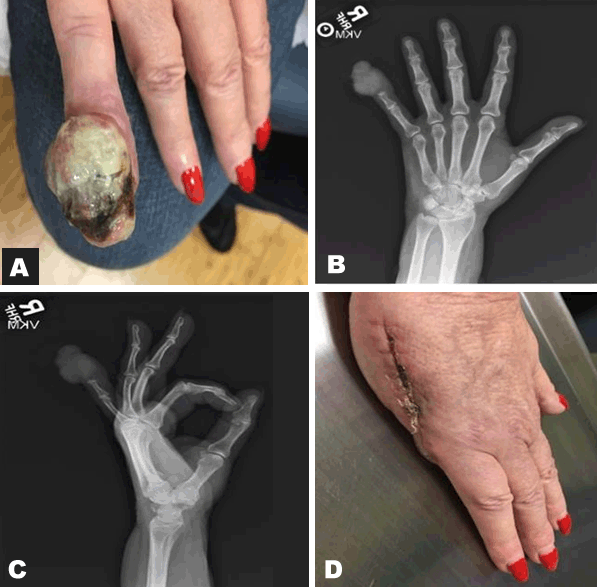
This is a 69-year-old female with a history of squamous cell carcinoma of the anal canal who presented with a two week history of a mass at the base of the right fifth digit (pinky finger) with foul smelling discharge (Figure 1A). Five months prior, she noticed a small bruise in the area and related it to a recent trauma.
She was initially diagnosed with localized anal cancer in 2012 and treated with concurrent chemoradiation. In 2015, she was found to have two lung metastases and had wedge resections for both diagnosis and treatment of metastatic disease. Unfortunately, she progressed in the lung and received several chemotherapy regimens and most recently immunotherapy with Nivolumab (anti-PD-L1). However, Nivolumab caused severe autoimmune hypothyroidism, significant facial and lower extremity swelling.
To work up the pinky finger lesion, she had X-rays (Figure 1B and 1C) in February 2018 which showed a heterogeneously dense and lobulated mass with extension into the dorsal soft tissue and associated swelling with near complete destruction of the fifth distal phalanx. Differential diagnosis remained broad and included trauma, infection such as abscess, osteomyelitis, or paronychia, unreported autoimmune reaction to novel biologics such as Nivolumab, a subungal melanoma, or digital metastasis. Amputation of the fifth phalanx showed poorly differentiated carcinoma with basaloid squamous features morphologically consistent with her primary anal cancer. Both the anal biopsy and finger amputation specimens had strong diffuse immunohistochemical p16 expression, indicating human papillomavirus (HPV) positivity. The tumor cells also stained positive with P63 and CK5/6 and negative with CK7, CK20, synaptophysin, chromogranin and CD56, supporting metastatic squamous cell with basaloid features originating from the anus.
She had an excellent cosmetic and functional result from the surgery (Figure 1D) and is alive now after seven months follow up.
DISCUSSION
Acrometastases are defined as malignant secondary lesions of the bones located in the acral regions (hands and/or feet) and account for only about 0.1% of metastases [1]. Based on literature reviews, men are twice as likely as women to develop acrometastases [2] and the median age is ~60 years [2],[3]. Acrometastases most commonly originate from primaries in the lung (44%), kidney (12%), breast (12%) and colon or rectum (6%) [3],[4].
The pathophysiology of development of acrometastases is unknown, but theories include hematogenous spread by embolic malignant cells or trauma [5]. Theoretically, these mechanisms may favor development of acrometases on the dominant hand, given increased blood flow and potential for more use and therefore more risk of trauma, but this has been controversial in the literature with some reviews finding a predilection to the dominant hand and others finding a relatively equal distribution [3],[5].
Generally, acrometastases are treated with a surgical approach, with amputation or excision, but radiation therapy has also been used with good palliation of symptoms and preservation of function [6]. Despite treatment, these patients generally have a poor prognosis with a median survival of 6–7 months, as the acrometastasis is an indication of widely metastatic disease [3],[7],[8]. However, several studies have reported increasing numbers of cases of acrometastases in the literature [2] and this may become a more prevalent issue as cancer patients live longer with better/novel systemic therapies.
Acrometastases are quite rare, but are most commonly found in patients with metastatic lung, breast and colorectal primaries. This case will be the second known reported case in the literature of an acrometasasis from squamous cell carcinoma of the anus. Previously, only one case out of 221 in a comprehensive literature review from 1986 to 2013 was from a primary anal cancer. It was the notoriously more aggressive basaloid histology, similar to our case, with acrometastases to the distal phalanx of the right left ring fingers [2],[9]. As reported by Flynn et al., the distal phalanx is the most frequently affected part of the hand and the third digit, followed by the thumb and then ring finger are most commonly involved [3].
Based on large literature reviews, men are twice as likely as women to develop acrometastases [2] and the median age is ~60 years, similar to our patient [2],[3]. Generally, patient’s present similar to our patient with a vague history of trauma. It is more common to incur trauma on the dominant hand, as in this case.
Acrometastases are an indication of widespread hematogenous spread of disease and therefore patients do not typically do well even after successful management of the hand or foot lesion, with a median survival of 6-7 months [3],[7],[8]. Our patient is now seven months post-amputation and was being evaluated for a clinical trial until her performance status started to decline. Unfortunately, she had progression of disease in the lungs and spine and is now considering hospice admission.
CONCLUSION
This is an unusual case of a woman with an acrometastasis to the pinky finger from her metastatic squamous cell carcinoma of the anal canal. This has unusual case pattern of spread for anal squamous cell carcinoma and the work up and diagnosis in this case is an illustration of the importance of physical examination and a high clinical index of suspicion that unusual sites can be involved with metastatic disease.
REFERENCES
1.
Kerin R. Metastatic tumors of the hand. A review of the literature. J Bone Joint Surg Am 1983 Dec;65(9):1331–5.
[Pubmed]

2.
Afshar A, Farhadnia P, Khalkhali H. Metastases to the hand and wrist: An analysis of 221 cases. J Hand Surg Am 2014 May;39(5):923–32.e17. [CrossRef]
[Pubmed]
3.
Flynn CJ, Danjoux C, Wong J, et al. Two cases of acrometastasis to the hands and review of the literature. Curr Oncol 2008 Oct;15(5):51–8. [CrossRef]
[Pubmed]
4.
Stomeo D, Tulli A, Ziranu A, Perisano C, De Santis V, Maccauro G. Acrometastasis: A literature review. Eur Rev Med Pharmacol Sci 2015 Aug;19(15):2906–15.
[Pubmed]
5.
Healey JH, Turnbull AD, Miedema B, Lane JM. Acrometastases. A study of twenty-nine patients with osseous involvement of the hands and feet. J Bone Joint Surg Am 1986 Jun;68(5):743–6.
[Pubmed]
6.
Kumar N, Kumar R, Bera A, et al. Palliative and supportive care in acrometastasis to the hand: Case series. Indian J Palliat Care 2011 Sep;17(3):241–4. [CrossRef]
[Pubmed]
7.
Mavrogenis AF, Mimidis G, Kokkalis ZT, et al. Acrometastases. Eur J Orthop Surg Traumatol 2014 Apr;24(3):279–83. [CrossRef]
[Pubmed]
8.
Hsu CS, Hentz VR, Yao J. Tumours of the hand. Lancet Oncol 2007 Feb;8(2):157–66. [CrossRef]
[Pubmed]
9.
Verardino GC, Silva RS, Obadia DL, Gripp AC, Alves Mde F. Rare cutaneous metastasis from a probable basaloid carcinoma of the colon mimicking pyogenic granuloma. An Bras Dermatol 2011 May–Jun;86(3):537–40. [CrossRef]
[Pubmed]
SUPPORTING INFORMATION
Author Contributions
Soumya Murag - Substantial contributions to conception and design, Acquisition of data, Analysis of data, Interpretation of data, Drafting the article, Revising it critically for important intellectual content, Final approval of the version to be published
Jennifer L. Myers - Substantial contributions to conception and design, Acquisition of data, Analysis of data, Interpretation of data, Drafting the article, Revising it critically for important intellectual content, Final approval of the version to be published
Bryce Hatfield - Substantial contributions to conception and design, Acquisition of data, Analysis of data, Interpretation of data, Drafting the article, Revising it critically for important intellectual content, Final approval of the version to be published
Emma C. Fields - Substantial contributions to conception and design, Acquisition of data, Analysis of data, Interpretation of data, Drafting the article, Revising it critically for important intellectual content, Final approval of the version to be published
Guaranter of SubmissionThe corresponding author is the guarantor of submission.
Source of SupportNone
Consent StatementWritten informed consent was obtained from the patient for publication of this clinical image.
Data AvailabilityAll relevant data are within the paper and its Supporting Information files.
Conflict of InterestAuthors declare no conflict of interest.
Copyright© 2018 Soumya Murag et al. This article is distributed under the terms of Creative Commons Attribution License which permits unrestricted use, distribution and reproduction in any medium provided the original author(s) and original publisher are properly credited. Please see the copyright policy on the journal website for more information.


