
 |
| Case Series | ||||||
| Treatment of early chronic infections with tumor prosthesis by intermittent negative pressure wound therapy with instillation | ||||||
| Yalçın Turhan1, Korhan Özkan2, Esat Uygur3, Murat Demiroğlu4, Bülent Erol5, Hüseyin Çoban6 | ||||||
| 1Assistant Professor, Orthopedics and Traumatology Department, Duzce University Medical Faculty, Duzce, Turkey 2Professor, Orthopedics and Traumatology Department, Medeniyet University Medical Faculty, Istanbul, Turkey 3Assistant Professor, Orthopedics and Traumatology Department, Medeniyet University Medical Faculty, Istanbul, Turkey 4MD, Orthopedics and Traumatology Department, Medeniyet University Medical Faculty, Istanbul, Turkey 5Professor, Orthopedics and Traumatology Department, Marmara University Medical Faculty, Istanbul, Turkey 6MD, Infectious Diseases and Clinical Microbiology, ELAB, Istanbul, Turkey | ||||||
| ||||||
| [HTML Abstract]
[PDF Full Text][Print This Article] [Similar articles in PubMed][Similar articles in Google Scholar] |


| How to cite this article |
| Turhan Y, Özkan K, Uygur E, Demiroğlu M, Erol B, Çoban H. Treatment of early chronic infections with tumor prosthesis by intermittent negative pressure wound therapy with instillation. J Case Rep Images Oncology 2018;4:100055Z10YT2018. |
| ABSTRACT | ||||||
|
Introduction: Vacuum-assisted closure (VAC) has been used to manage nearly every type of wound seen in orthopedic field including early prosthetic hip and knee infections. In this study, we aimed to present our treatment results of two patients with total and proximal femoral mega prosthesis respectively. Case Series: With the diagnosis of periprosthetic infection, in both cases, prosthesis were disassembled and sterilized in autoclave. Prosthesis were reimplanted after sterilization and Vacuum Assisted Closure system with instillation. Patients were successfully treated and no signs of infection were detected until ten to twelve months postoperatively. Conclusion: Mega prosthetic infections pose a great challenge to an orthopedic surgeon and the patient. Besides its economic cost, it causes significant morbidity to the patient. Intermittent negative pressure wound therapy with instillation may be promising technique for the treatment of devastating infections associated with tumor prosthesis. Keywords: Infection, Instillation, Megaprosthesis, Vacuum assisted closure | ||||||
| INTRODUCTION | ||||||
|
Vacuum-assisted closure (VAC) has been used to manage nearly every type of wound seen in orthopedic field including early prosthetic hip and knee infections. Topical usage of prolonged negative pressure to promote healing of wounded tissue was first described by Fleischmann [1]. VAC uses negative pressure to remove excess fluid, debris and enhances tissue perfusion with granulation tissue formation. However, it is not clear if it has a positive effect in lowering bacterial bio-burden in infected wounds which leads to the innovation of VAC instill and VAC therapy with silver-coated foam. Megaprostheses are used in selected patients with bone tumors and can be defined as special bone and joint prosthesis which help to compensate large bone defects as a result of bone stock loss like in malignant bone tumors. Although Lehner and Bernd reported good outcome with VAC instill therapy for an early chronic periprosthetic hip and knee infections, there have been no literature about the VAC instill therapy for the treatment of early chronic infections of mega prosthesis [2]. In this study, we aimed to present our treatment results of two patients with total and proximal femur mega prosthesis respectively. | ||||||
| CASE REPORT | ||||||
|
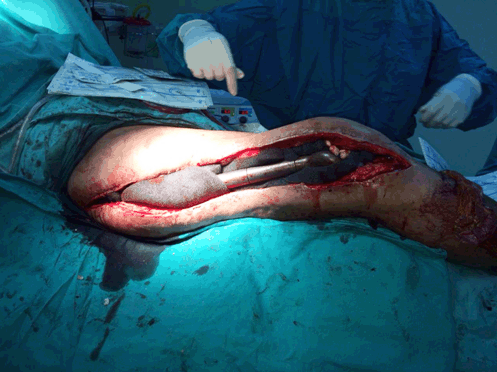
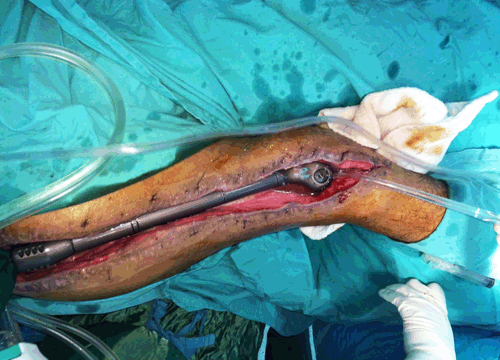
Case 1 The patient was doing well until he presented with a fistula at his distal thigh after six months postoperatively. His culture revealed Acinetobacter baumanni. Her CRP level was 23 mg/dL (normal value is less than 1) and ESR was 82 mm/h. He was operated on with the diagnosis of periprosthetic infection. The total femoral mega prosthesis was completely disassembled and extensive debridement with polyethylene liner changing was done. After re-sterilization of the whole femoral prosthesis in a sterilization unit, it was re-implanted. However drainage persisted one week after the procedure. Then, he was operated again with changing polyethylene liners and resterilization of the femoral component. But this time VAC instill (VAC Instill®, Therapy system-KCI Medical, San Antonio, Texas, USA) therapy had been started (Figure 1). A negative pressure of 200 mmHg was applied for two days and then the pressure was decreased to 125 mmHg with 12 cycles of instillation per day (dwell time: 30 minutes) using polyhexanide biguanide (PHMB + Betaine) wound irrigation solution [Prontosan® B.Braun Medical, Melsungen, Germany]. One week later, drained fluid was serous in nature and the sponges were removed under general anesthesia with additional debridment and new sponges were put in. The wound was clean and well granulated (Figure 2). The cultures of the sponges were negative. At the following week, his sponges were removed again and the week after primary closure was done. His inflammatory markers decreased to normal values {C-reactive protein (CRP) was 0,6mg/dL and erythrocyte sedimentation rate (ESR) was 15mm/h}. He is well 12 months of postoperatively with no signs of infection.
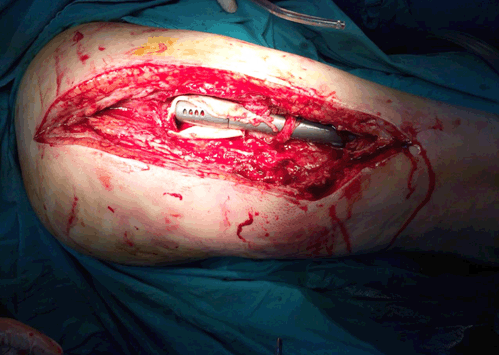
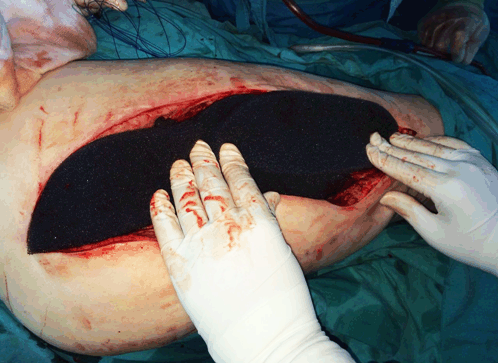
Case 2 A negative pressure of 200 mmHg was applied for two days and then the pressure was decreased to 125 mmHg with 12 cycles of instillation per day (dwell time: 30 minutes) using polyhexanide biguanide (PHMB + Betaine) wound irrigation solution [Prontosan ® B.Braun Medical, Melsungen, Germany]. One week later, the drained fluid was still not serous in nature and the sponges were removed under general anesthesia with debridement and the new sponges were put in. The following week the drained fluid returned to serous nature and the sponges were changed again. At the following week, primary closure was done. Patient’s CRP and ESR levels also decreased to normal values (CRP was 0,8mg/dL and ESR was 18mm/h). She is well with no signs of infection with 10 months postoperatively. | ||||||
| ||||||
| ||||||
| ||||||
| ||||||
DISCUSSION | ||||||
|
Limb salvage surgery with endoprosthetic replacement is the most common reconstruction for patients with sarcoma. The infection rate is high compared to conventional knee and hip arthroplasty, which has been reported to be between 0.2% and 4% [3] . Periprosthetic infections remain the main complications of arthroplasty. Racano et al reported that the risk of postoperative infections for limb salvage surgery with endoprosthetic replacement was approximately 10% [4]. In early infections, the implant can often be left in place with radical debridement and polyethylene replacement until 4 weeks after the operation. However, in late infections, in addition to radical debridement all prostheses must be revised to eradicate infection by either one- or usually two-stage revision. However, this results in significant economic costs and patient morbidity [5]. The current literature tends to support a two-stage revision as the definitive treatment for established prosthetic infection. The successful eradication of a total joint replacement infection with a two-stage re-implantation protocol is over 90%, while the success rate with a one-stage protocol is approximately 80% [6]. In these two cases, prosthesis were sterilized into autoclave and reimplanted again. Although autoclaved tumor bone for reconstruction is a known technique in tumor surgery [7],[8], to the best of our knowledge this method has not been reported before in infected tumor prosthesis surgery. Reviews of the literature have shown a proteoglycan-containing biofilm covers the implant and acts as a barrier for the pathogens to protect them from host anti-inflammatory responses [9],[10]. Complete eradication of the pathogen is impossible in most cases, because many antibiotics administered intravenously cannot penetrate this biofilm [10]. When used for bone fixation, the implants are needed only temporarily and can be removed when the fracture is healed, but in prosthetic operations this couldn’t be possible. Vacuum-assisted closure (VAC) has been used to treat for these types of infections in orthopaedic surgery including early prosthetic hip and knee infections [1]. VAC-Instill therapy is a combination of traditional negative pressure wound therapy and intermittent instillation of a topical wound treatment solution [2]. It is composed of three phases: instillation of saline, local antiseptics, or antibiotics followed by a delay to allow the solution to soak and finally the application of negative pressure to the wound for the suction of fluids and debris. Different antiseptic solutions for wound irrigation (eg, polyhexamine bigluconate [PHMB], saline, or antibiotics) can be considered. Relevant evidence regarding dwell time, the level of negative pressure, and the frequency of the instillation is not described in the literature. We chose polyhexanide biguanide (PHMB + Betaine) as the wound irrigation solution. An in vitro study by Ikeda et al showed an advantage to using PHMB for the treatment of soft-tissue injuries without bone involvement compared to povidone-iodine and silver nitrate [11]. The use of a PHMB solution is advised when treating infections similar to those described in this study [12],[13]. A small in vitro study showed wound dressings combined with PHMB lowered bacterial activity in 32% of the tested samples [13]. The successful use of intermittent NPWTi for early acute and early chronic periprosthetic infections has also been reported. Lehner and Bernd reported the successful treatment of knee and hip periprosthetic infections with intermittent NPWTi [2]. Instillation of antibiotics and local antiseptics to the wound bed and intermittent negative pressure acting together may enhance distorded vascularization and oxygenation of the infeced soft tissue with the possible contribution to eradication of bacterial biofilm. | ||||||
| CONCLUSION | ||||||
|
Mega prosthetic infections pose a great challenge to an orthopedic surgeon and the patient. Besides its economic cost, it causes significant morbidity to the patient. Intermittent negative pressure wound therapy with instillation may be promising technique for the treatment of devastating infections associated with tumor prosthesis. However further studies are needed. | ||||||
| REFERENCES | ||||||
| ||||||

|
[HTML Abstract]
[PDF Full Text]
|
| Author Contributions
Yalçın Turhan – Substantial contributions to conception and design, Acquisition of data, Drafting the article, Revising it critically for important intellectual content, Final approval of the version to be published Korhan Özkan – Substantial contributions to conception and design, Analysis and interpretation of data, Drafting the article, Final approval of the version to be published Esat Uygur – Substantial contributions to conception and design, Drafting the article, Revising it critically for important intellectual content, Final approval of the version to be published Murat Demiroğl – Substantial contributions to conception and design, Analysis and interpretation of data, Drafting the article, Final approval of the version to be published Bülent Erol – Substantial contributions to conception and design, Acquisition of data, Drafting the article, Revising it critically for important intellectual content, Final approval of the version to be published Hüseyin Çoban – Substantial contributions to conception and design, Drafting the article, Revising it critically for important intellectual content, Final approval of the version to be published |
|
Guarantor of Submission
The corresponding author is the guarantor of submission. |
|
Source of Support
None |
|
Consent Statement
Written informed consent was obtained from the patient for publication of this case series. |
|
Conflict of Interest
Author declares no conflict of interest. |
|
Copyright
© 2018 Yalçın Turhan et al. This article is distributed under the terms of Creative Commons Attribution License which permits unrestricted use, distribution and reproduction in any medium provided the original author(s) and original publisher are properly credited. Please see the copyright policy on the journal website for more information. |
|
|