|
|
Case Report
| ||||||
| A case of squamous cell carcinoma of oral cavity treated with radical radiation in a patient with Fanconi anemia | ||||||
| Ashwini Gopal1, Deleep Kumar Gudipudi2 | ||||||
|
1DMRT, DNB RT, Registrar, Department of Radiation Oncology, Basavatarakam Indo American Cancer Hospital and Research institute, Hyderabad, Telangana, India 2DNB RT, Consultant, Department of Radiation Oncology, Basavatarakam Indo American Cancer Hospital and Research Institute, Hyderabad, Telangana, India | ||||||
| ||||||
|
[HTML Abstract]
[PDF Full Text]
[Print This Article]
[Similar article in Pumed] [Similar article in Google Scholar] |
| How to cite this article |
| Gopal A, Gudipudi DK. A case of Squamous cell carcinoma of oral cavity treated with radical radiation in a patient with Fanconi anemia. J Case Rep Images Oncology 2017;3:69–72. |
|
ABSTRACT
|
|
Introduction:Fanconi anemia is an autosomal or X-linked recessive disorder due to germ-line mutations in DNA repair genes. head and neck squamous cell carcinoma (HNSCC) is the most common solid tumor in Fanconi anemia, of which oral cavity tumors are the most common. Due to impaired DNA repair mechanism these patients will have higher treatment related toxicity with radiotherapy and chemotherapy and concurrent chemotherapy is not an option. Case Report: We report a case of Fanconi anemia presented with carcinoma of oral cavity (Upper alveolus c T3 N0 M0), who was treated with radical radiation with reduced dose using volumetric modulated arc radiotherapy (VMAT i.e., rapid arc intensity modulated radiotherapy) with simultaneous integrated boost (SIB) with acceptable toxicity. She received 63.6 Gy to GTV, 54 Gy to high risk CTV, 49.5 Gy to low risk CTV in 30 fractions. She developed Grade II mucositis, Grade III fatigue, and Grade II skin reaction during the course of radiation. Patient is disease free and alive after 20 months of diagnosis. Conclusion:Radical radiation with reduced dose can be used as effective treatment in patients with Fanconi anemia in carcinoma oral cavity with acceptable acute toxicity and good local control. | |
|
Keywords: Carcinoma oral cavity, Fanconi anemia, Radiation, Rapid arc IMRT | |
|
INTRODUCTION
| ||||||
|
Fanconi anemia is an inherited disorder due to germ line mutation in DNA repair gene. Gene involved are Fanconi anemia complementation groups (FANC) A/B/C/D1/D2/E/F/G/I/J/L//M/N/O/P [1]. Bone marrow failure, congenital defects and increase chances of malignancy are features of Fanconi anemia [2]. They are prone to develop leukemia like acute myeloid leukemia and solid tumors of aerodigestive tract and gynecological malignancies. Head and neck squamous cell carcinoma (HNSCC) is the most frequently diagnosed solid tumors. Primary tumors predominantly occur in the oral cavity in sub sites such as tongue or the gingiva. Cumulative incidence of solid cancers is 28% by the age of 40 [3]. Current management of locally advanced oral cavity carcinoma is surgery followed by adjuvant radiation or chemo-radiation. The cells of Fanconi anemia patients are very sensitive to DNA damage due to their inability to repair DNA damage. They are very sensitive to radiation and chemotherapy drugs, which causes DNA damage [4]. Cisplatin cannot be used as it produces DNA adduct and causes high toxicities and may be result in organ failures. Radiotherapy can be used in these patients but has severe treatment related complications such as mucositis, skin reactions and dysphagia [5]. We herein report a case of Fanconi anemia presented with squamous cell carcinoma of upper alveolus who was treated with radical intent with reduced dose of radiation. Currently, patient is alive and is disease free for 20 months. | ||||||
|
CASE REPORT
| ||||||
|
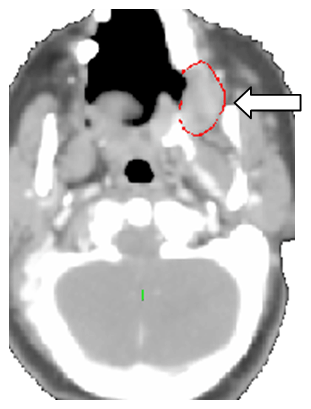
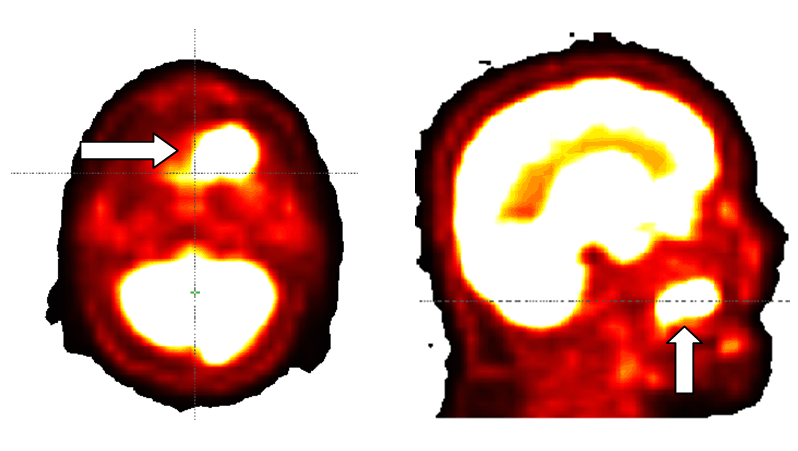
A 34-year-old female born to consanguineous marriage presented with complaints of ulcer in hard palate for one month. On examination she had a short stature, short neck, cafe au lait spots and low-lying ears. Local examination of oral cavity showed ulcero-proliferative growth in left upper alveolus measure 5 cm in the greatest dimension, with no neck nodes palpable. Biopsy from lesion was squamous cell carcinoma, Grade II. She was diagnosed as carcinoma left upper alveolus c T3 N 0 M 0 Stage III. Baseline blood investigation showed pancytopenia with hemoglobin 4.9 g/dl, TLC 2.13x10⁹/L, neutrophils 20, lymphocyte 29, eosinophils 1. Bone marrow biopsy showed features suggestive of aplastic marrow. Bone marrow cytological features suggestive of hypo cellular marrow. She was diagnosed with Fanconi anemia. She received blood transfusion for correction of blood parameters. Planning PET CT scan was done and showed hyper metabolic soft tissue lesion in left upper alveolus with destruction of floor of left maxillary sinus and few sub centimeter left level Ia and Ib nodes (Figure 1) and (Figure 2). Surgery was not done in view of low platelet counts and resection could have been an extensive in view of maxillary sinus involvement. The patient was planned for radical radiotherapy by RIMRT (rapid arc intensity modulated radiotherapy) with PET CT based radiotherapy planning using simultaneous integrated boost (SIB). She was enrolled for honey study for evaluation of mucositis, she was asked to swish and swallow 15–20 ml honey 3 times a day before and after radiation and at bedtime. Patient completed 30 fractions that is 63.6 Gy to GTV, 54 Gy to high risk CTV, 49.5 Gy to low risk CTV in 40 days, over six weeks without treatment interruption. She did not receive any concurrent chemotherapy. During treatment she was regularly assessed for acute reactions and blood counts. She was given opioid analgesics for adequate pain relief during radiation. She developed Grade II mucositis, Grade III fatigue, and Grade II skin reaction during the course of radiation for which symptomatic treatment was given. The patient is disease free with good loco regional control and is alive, and is under regular follow-up. After 20 months of follow-up she has Grade II xerostomia, and able eat, swallow and talk normally. | ||||||
| ||||||
| ||||||
|
DISCUSSION
| ||||||
|
Fanconi anemia patients are more sensitive to DNA damage due to inherent defect in DNA repair mechanisms. Radiation in these patients is quite challenging due to increased acute toxicity. On the other hand, cancer cells in these patients are more sensitive to radiation and reduced dose might be sufficient to achieve cure. Cancers of head and neck occurs at young age compared to the general population [6]. These patients usually do not have history of tobacco use on contrary to Head and neck cancers in general population. Squamous cell carcinoma of oral cavity is managed by surgery followed by adjuvant radiation or chemoradiation. Fanconi anemia patients can tolerate complex ablative and reconstructive surgeries, but careful postoperative care is required to reduce morbidity. Postoperative wound infections, acute respiratory distress syndrome, and hematoma after flap reconstruction, pharyngocutaneous fistulas are reported [6]. Postoperative radiation to a dose 60 Gy to 66 Gy is necessary when there are high risk features for recurrence in general population. Studies show mean dose of radiation was 5570 Gy for postoperative radiotherapy and the overall mortality was high in these patients with a mean overall survival of 33.7 months. Disease-free survival was poor, with a mean disease-free interval of 15.7 months [7]. In this case report, we see younger age at presentation and no consumption of tobacco products. The patient has received lesser total dose of radiation 63.6 Gy, but dose per fraction being 2.12 Gy to tumor with BED (biological effective dose) of 77 Gy to tumor, on contrary to radical dose which had BED of 84 Gy. She received treatment with rapid Arc IMRT, resulting in reduced dose to surrounding normal and critical structures. Though Fanconi anemia patients develop greater acute toxicity, our patient developed Grade II mucositis due to use of honey (which might have helped in reducing mucositis). With 20 months from diagnosis, she is disease free and has grade II xerostomia with good quality of life. | ||||||
|
CONCLUSION
| ||||||
|
We conclude that patients with Fanconi anemia with cancer in oral cavity can be treated with radical radiation with reduced dose with acceptable acute and late toxicities. Adjusting radiation dose is necessary to treat Fanconi anaemia patient due complications of radiation. Reduced dose can be beneficial as it reduces complication as well as there is no compromise in tumor control, as the cells are radiosensitive. | ||||||
|
REFERENCES
| ||||||
| ||||||
|
[HTML Abstract]
[PDF Full Text]
|
|
Author Contributions
Ashwini Gopal – Substantial contributions to conception and design, Acquisition of data, Analysis and interpretation of data, Drafting the article, Revising it critically for important intellectual content, Final approval of the version to be published Deleep Kumar Gudipudi – Substantial contributions to conception and design, Acquisition of data, Analysis and interpretation of data, Drafting the article, Revising it critically for important intellectual content, Final approval of the version to be published |
|
Guarantor of Submission
The corresponding author is the guarantor of submission. |
|
Source of Support
None |
|
Conflict of Interest
Authors declare no conflict of interest. |
|
Copyright
© 2017 Ashwini Gopal et al. This article is distributed under the terms of Creative Commons Attribution License which permits unrestricted use, distribution and reproduction in any medium provided the original author(s) and original publisher are properly credited. Please see the copyright policy on the journal website for more information. |