
 |
|
Case Report
| ||||||
| Rare variety of breast cancer in a young girl: A case report | ||||||
| Arman Reza Chowdhury1, Moarraf Hossen2, Qazi Mushtaq Hussain3, Aliya Shahnaz3, Wasek Faisal4 | ||||||
|
1MBBS, Junior Consultant, Department of Oncology, Delta Hospital Ltd, Dhaka, Bangladesh
2MBBS, Director, National Institute of Cancer Research & Hospital, Dhaka, Bangladesh 3MBBS, Associate Professor, Department of Radiotherapy, Dhaka Medical College & Hospital, Dhaka, Bangladesh 4MBBS, Visiting Consultant, Department of Oncology, Delta Hospital Ltd, Dhaka, Bangladesh | ||||||
| ||||||
|
[HTML Abstract]
[PDF Full Text]
[Print This Article]
[Similar article in Pumed] [Similar article in Google Scholar] |


| How to cite this article: |
| Chowdhury AR, Hossen M, Hussain QM, Shahnaz A, Faisal W. Rare variety of breast cancer in a young girl: A case report. J Case Rep Images Oncology 2017;3:25–28. |
|
ABSTRACT
|
|
Introduction:
Secretory carcinoma is a rare low-grade breast carcinoma. Although originally described in children, it is now known to occur in adults of both sexes. Distant metastases from secretory carcinoma are extremely rare but the overall incidence of axillary lymph node infiltration is around 30% in children and adults regardless of gender.
Case Report: This paper includes a case report of secretory carcinoma in a young girl, which was managed by surgical treatment including local recurrence but no other adjuvant therapy. Conclusion: Secretory breast carcinoma can be a diagnostic challenge histologically. In the absence of any consensus guidelines, treatment decisions are based on data extrapolated from more common varieties of breast cancer. | |
|
Keywords:
Breast cancer, Rare cancer, Secretory carcinoma
| |
|
INTRODUCTION
| ||||||
|
Secretory carcinoma of the breast is a rare form of breast cancer accounting for less than 1% of all breast cancers. It was initially labeled as juvenile breast cancer because of identification of index cases in adolescent girls, with an average age of onset of nine years in a case series [1]. Conventionally, this has been considered to be an indolent malignancy with a long and quiescent natural history, but secretory carcinoma can have nodal metastases and local recurrence after surgical resection [2]. Tumor size smaller than 20 mm, age of onset below 20 years and tumors with well circumscribed margins have been suggested as features that carry a favorable prognosis [3]. DeBree found that secretory carcinomas in men appear to be more aggressive [4]. Herein, we report a case of secretory carcinoma in a Bangladeshi girl followed by a brief literature review to provide the context of management and current knowledge. | ||||||
|
CASE REPORT
| ||||||
|
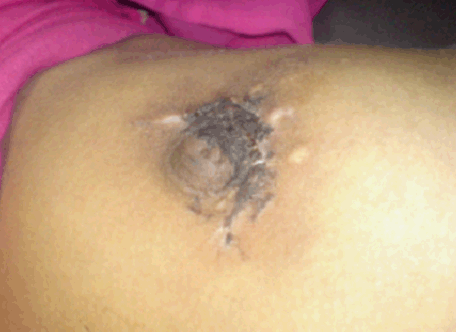
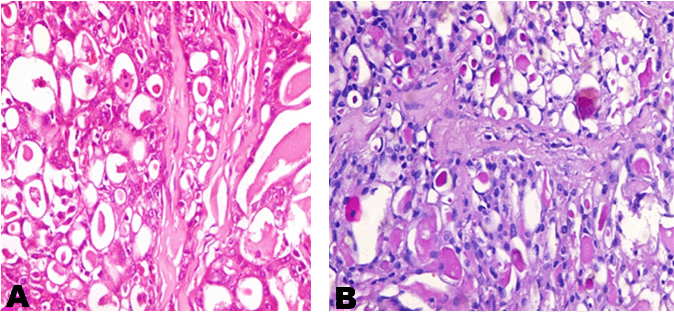
A 10-year-old girl, hailing from Noakhali district of Bangladesh noticed a small mass in her left breast region, which was gradually increasing in size. She underwent wide local excision of the mass in June 2010 by a local general surgeon. Unfortunately, the surgical specimen was not sent for formal histopathology at the time. Postoperatively, she was well for six months, following which she again felt a painful palpable mass at the same site beneath the scar line (Figure 1). Fine needle aspiration cytology of the presumed local recurrence did not reveal any malignant cells. She underwent a further lumpectomy in March 2011, and was referred to the Department of Radiotherapy, Dhaka Medical College and Hospital for further management. The histopathology of the resected local recurrence was confirmed as secretory carcinoma of breast on expert review. Receptor status (ER, PR, Her 2) was not performed. She subsequently underwent simple mastectomy with axillary clearance at Dhaka Medical College and Hospital. Histopathology revealed juvenile (Secretory) carcinoma of breast (Figure 2). All margins were negative. No lymphovascular or perineural space invasion was seen. None of the resected lymph nodes had malignant deposit. No adjuvant chemotherapy or radiotherapy was given. The patient had an unremarkable postoperative recovery and had been free of cancer recurrence on serial follow-up for up to nine months (Figure 3) when she was lost to follow-up. | ||||||
| ||||||
|
| ||||||
| ||||||
|
DISCUSSION
| ||||||
|
Although secretory carcinoma was originally described in young children, it is increasingly being recognized as a cancer that can occur in any age in both sexes. Typically, it presents as a painless, discrete, slow-growing mass found incidentally during breast self-examination. Rare incidences in ectopic breast tissue in axilla have also been reported. Tumors less than 20 mm rarely metastasizes to the axillary nodes and nodal status (if present) is usually N2 or less. Secretory carcinomas are usually triple-negative, implying absence of any hormone-dependent pathways in its pathogenesis. This also is supported by the fact that they often occur in pre-pubertal age and in men. The tumors of secretory breast carcinoma are consistently positive for S100, EMA, PAS and lactalbumin on immunohistochemistry, which can be very useful in differentiating this rare entity during diagnostic phase. A unique fusion gene (ETV6-NTRK3) has been identified in secretory breast carcinoma, which has previously been detected in congenital fibrosarcoma and congenital mesoblastic-nephroma, but not in any other types of breast cancer. Despite its unique presence in this type of breast cancer, it is uncertain if this fusion gene is a driver mutation in the pathogenesis of secretory carcinoma [3][4][5][6][7][8][9]. Like many other rare cancers, there are no consensus guidelines at present for the treatment of secretory breast carcinomas. Based on expert opinions and published case series, surgical excision with or without sentinel node biopsy (and axillary nodal clearance, if appropriate) is the primary mode of treatment. Breast conserving surgery, although desirable in pre-pubertal patients for obvious physical and psychological reasons, might not be always possible due to tumor location and size. Decision regarding adjuvant chemotherapy and radiotherapy are extrapolated from the data from other common types of breast cancer (i.e. high-risk, node-positive disease) but can be safely deferred until disease recurrence in low-to-intermediate-risk disease [6]. Node-negative secretory carcinomas are thought to have an excellent prognosis, but can present with late relapse, mostly with local recurrence although systemic metastasis has been reported uncommonly which are thought to be generally chemo-resistant [10]. | ||||||
|
CONCLUSION
| ||||||
|
In summary, secretory carcinomas are a rare entity with distinct histologic, molecular and genetic signatures, which can pose a diagnostic and therapeutic challenge because of the paucity of data on this type of cancer. We hope this case report will add to the growing dataset of this cancer, which carries a favorable prognosis. | ||||||
|
REFERENCES
| ||||||
| ||||||


|
[HTML Abstract]
[PDF Full Text]
|
|
Author Contributions
Arman Reza Chowdhury – Substantial contributions to conception and design, Acquisition of data, Drafting the article, Revising it critically for important intellectual content, Final approval of the version to be published Moarraf Hossen – Substantial contributions to conception and design, Acquisition of data, Drafting the article, Revising it critically for important intellectual content, Final approval of the version to be published Qazi Mushtaq Hussain – Substantial contributions to conception and design, Acquisition of data, Drafting the article, Revising it critically for important intellectual content, Final approval of the version to be published Aliya Shahnaz – Substantial contributions to conception and design, Acquisition of data, Drafting the article, Revising it critically for important intellectual content, Final approval of the version to be published Wasek Faisal – Substantial contributions to conception and design, Acquisition of data, Drafting the article, Revising it critically for important intellectual content, Final approval of the version to be published |
|
Guarantor of submission
The corresponding author is the guarantor of submission. |
|
Source of support
None |
|
Conflict of interest
Authors declare no conflict of interest. |
|
Copyright
© 2017 Arman Reza Chowdhury et al. This article is distributed under the terms of Creative Commons Attribution License which permits unrestricted use, distribution and reproduction in any medium provided the original author(s) and original publisher are properly credited. Please see the copyright policy on the journal website for more information. |