| Table of Contents | |
|
Case Series
| |||||
| Safety and efficacy of endoscopic submucosal dissection for early gastric remnant cancers post-proximal gastrectomy with jejunal interposition | |||||
| Kaoru Omori1, Kanako Yoshida1, Toshiaki Kamei2, Masahiro Kan1 | |||||
|
1MD, PhD, Department of Gastroenterology and Hepatology, Sato Daiichi Hospital, 77-1 Hokyoji, Usa City, Oita 879-0454, Japan.
2MD, PhD, Medical Director of Pathology & Cytology Center BML group PCL, 5-20-25 Matsushima, Fukuoka City, Fukuoka 813-0062, Japan. | |||||
| |||||
|
[HTML Abstract]
[PDF Full Text]
[Print This Article]
[Similar article in Pumed] [Similar article in Google Scholar] |
| How to cite this article: |
| Omori K, Yoshida K, Kamei T, Kan M. Safety and efficacy of endoscopic submucosal dissection for early gastric remnant cancers post-proximal gastrectomy with jejunal interposition. J Case Rep Images Oncology 2016;2:47–51. |
|
Abstract
|
|
Introduction:
Endoscopic submucosal dissection has been widely accepted as a standard treatment for early gastric cancers. However, endoscopic submucosal dissection for an early gastric remnant cancer post-proximal gastrectomy with jejunal interposition is not yet widespread.
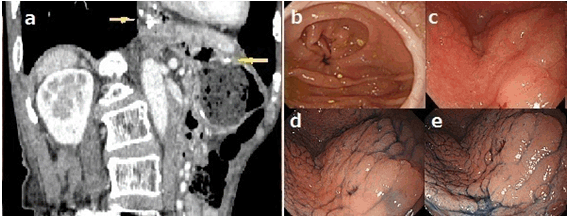
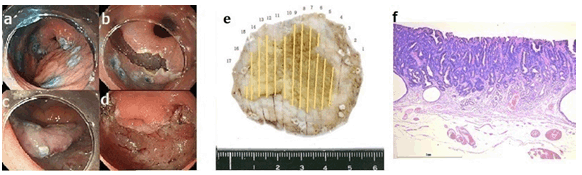
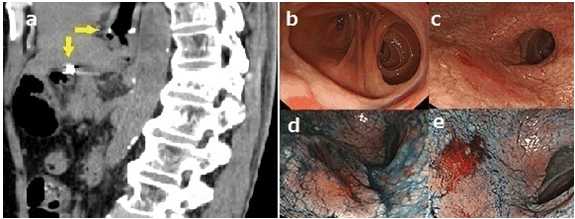
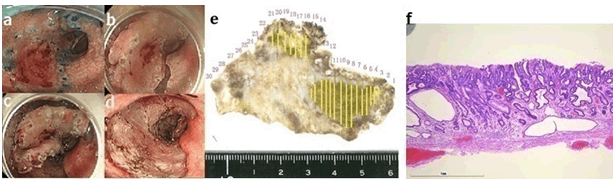
Case Series: A large, flat, elevated lesion was detected in an 83-year-old male (Case 1), whereas two separate flat, elevated lesions were detected in a 75-year-old male (Case 2). Successful curative en bloc resection of these lesions by endoscopic submucosal dissection using the insulation-tipped diathermic knife-2 revealed well-differentiated adenocarcinoma confined to the mucosa. No postoperative bleeding nor perforation was observed in the present cases. Conclusion: These cases underscore the importance of periodic upper gastrointestinal endoscopy follow-up and the value of endoscopic submucosal dissection using the insulation-tipped diathermic knife-2 for treating early gastric remnant cancers post-proximal gastrectomy in the presence of interposed jejunum, even when extensive removal is necessary. | |
|
Keywords:
Early gastric remnant cancer, Endoscopic submucosal dissection, Proximal gastrectomy, Insulation-tipped diathermic knife-2
| |
|
Introduction
|
|
Total gastrectomy for gastric cancer located in the proximal third of the stomach has been widely performed as a standard procedure to achieve tumor free margins and complete lymph node dissection [1]. Recently, proximal gastrectomy (PG) for early stage proximal gastric cancer has been accepted to preserve the physiologic function of the gastric remnant. In a previous report, the incidence of gastric remnant cancer (GRC) post-PG was higher than that of GRC post-distal gastrectomy (DG) [2]. It was previously considered that radical surgical resection was the only therapeutic procedure for GRC post-PG. On the other hand, endoscopic submucosal dissection (ESD) has been widely accepted as a standard treatment for early gastric cancers. Several knives, such as the needle, insulation-tipped diathermic (IT) knife-2, hook, flex and flush knives, are currently used. Selection of the proper knife influences the quality of the ESD procedure and overall outcome because of its own merits and disadvantages. Although ESD for an early GRC post-DG has been reported [3], ESD for an early GRC post-PG with jejunal interposition has been rarely reported. Herein, we report three lesions in two cases that underwent successful ESD using the IT knife-2 for early GRCs post-PG with jejunal interposition. The importance of periodic upper gastrointestinal endoscopy follow-up for the detection of a small early GRC post-PG to facilitate ESD and the possible benefits of ESD using the IT knife-2, even for an early GRC post-PG for which extensive removal is necessary, are emphasized. |
|
Case Series
|
|
Case 1 Case 2 |
|
|
|
|
|
|
|
|
|
|
|
Discussion
|
|
We experienced three early GRCs in two cases of PG with jejunal interposition that were successfully treated with extensive en bloc resection during ESD. Endoscopic submucosal dissection (ESD) for early gastric cancers with negligible risk of lymph node metastasis has been widely accepted as a standard treatment, while improving efficiency and safety of ESD. However, it is often more difficult to perform ESD in the remnant stomach than in the normal stomach because of a narrow working space in the gastric remnant, as well as the existence of fibrosis and staples under the suture line [5]. Post-PG endoscopic surveillance of the remnant stomach has been reported to be difficult because of the interposed jejunum [6]. Therefore, ESD for an early GRC, particularly post-PG with jejunal interposition, is not yet widespread. In our cases, both ESD procedures were an investigational treatment for early GRCs post-PG according to the expanded indication mentioned in the Japanese gastric cancer treatment guidelines [4]. Therefore, we consider that ESD for early GRCs post-PG with negligible risk of lymph node metastasis should follow two independent indications for ESD mentioned in the Japanese gastric cancer treatment guidelines [4]: the absolute indication for a standard treatment, and the expanded indication for an investigational treatment [4]. Selection of the proper knife from various knives, such as the needle, IT knife-2, hook, flex, and flush, influences the quality of the ESD procedure and overall outcome. One of the most important factors contributing to the safe completion of ESD for an early GRC post-PG with a narrow working space is careful dissection of the submucosal layer to prevent perforation. The IT knife-2 has a ceramic ball at the top of the incising needle knife to prevent perforation. Therefore, both ESD procedures were performed by technically qualified experts using the IT knife-2 in the present cases. The ESD procedure durations took longer than usual because of technical difficulties. Although the complications of ESD for GRCs post-DG have been reported to be perforation and delayed bleeding [3], these complications were not observed in the present cases. The incidence of early gastric cancer in the proximal third of the stomach has recently increased in Japan; PG has been accepted, considering the improvement of the quality of life after gastrectomy [7]. As a consequence, however, GRCs post-PG are now increasing [2]. Radical surgical resection was previously considered to be the only therapeutic procedure for curing GRCs post-PG. Recent advances in diagnostic techniques and endoscopic surveillance programs have increased the early detection of GRCs post-DG [8]. Similarly, early GRCs post-PG, even when extensive removal is necessary, may also be treatable by ESD, as demonstrated in our cases. Recently, favorable survival rates after endoscopic resection for early GRC have been reported [5]. ESD using the IT knife-2 for early GRCs post-PG in the presence of jejunal interposition was considered to be the safe and effective therapeutic procedure in the present cases. However, only highly skilled and experienced endoscopists should perform ESD for early GRCs post-PG with jejunal interposition because of technical difficulties, particularly when extensive removal is required, as observed in our cases. |
|
Conclusion
|
|
Use of the IT knife-2 contributed to the safe and effective ESD for early GRCs post-PG with jejunal interposition, for which extensive removal was necessary. Our cases suggest that the indications of ESD for early GRCs post-PG with negligible risk of lymph node metastasis should follow the Japanese gastric cancer treatment guidelines. |
|
Acknowledgements
|
|
We are grateful to Dr. Takeshi Okamoto, Institute for Department of Gastroenterology and Hepatology, Yamaguchi University Graduate School of Medicine, Japan, for his support in revising the manuscript. |
|
References
|
|
|
[HTML Abstract]
[PDF Full Text]
|
|
Author Contributions:
Kaoru Omori – Substantial contributions to conception and design, Acquisition of data, Analysis and interpretation of data, Drafting the article, Revising it critically for important intellectual content, Final approval of the version to be published Kanako Yoshida – Substantial contributions to conception and design, Acquisition of data, Analysis and interpretation of data, Drafting the article, Revising it critically for important intellectual content, Final approval of the version to be published Toshiaki Kamei – Substantial contributions to conception and design, Acquisition of data, Analysis and interpretation of data, Drafting the article, Revising it critically for important intellectual content, Final approval of the version to be published Masahiro Kan – Substantial contributions to conception and design, Acquisition of data, Analysis and interpretation of data, Drafting the article, Revising it critically for important intellectual content, Final approval of the version to be published |
|
Guarantor of submission
The corresponding author is the guarantor of submission. |
|
Source of support
None |
|
Conflict of interest
Authors declare no conflict of interest. |
|
Copyright
© 2016 Kaoru Omori et al. This article is distributed under the terms of Creative Commons Attribution License which permits unrestricted use, distribution and reproduction in any medium provided the original author(s) and original publisher are properly credited. Please see the copyright policy on the journal website for more information. |
|
|